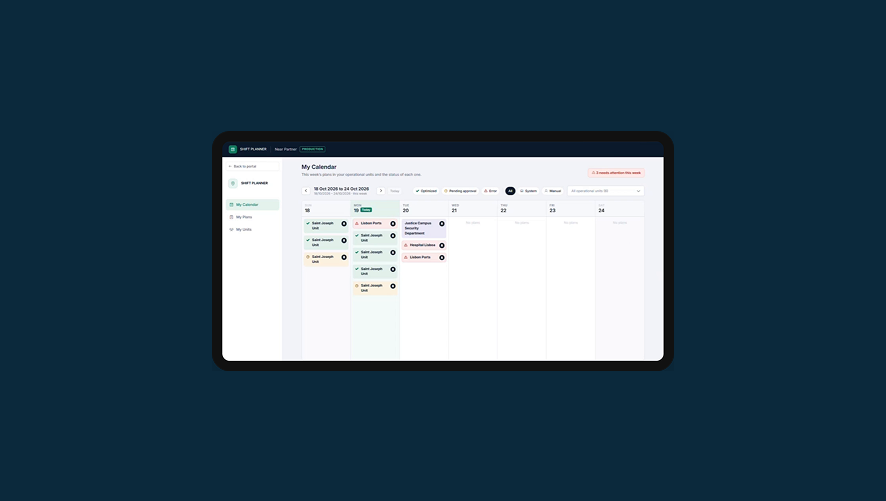
Maybe that’s you. Or maybe you know what happens when a schedule falls apart. AI can help with the repetitive calculations and checks. In one project, our AI shift planner – Shift Planner – generated hundreds of shifts in under two minutes and helped planners fill gaps in one click. So what is an AI shift planner, what should it do, and how can you introduce one?
What is an AI shift planner?
An AI shift planner is software that uses information about the shifts to be covered and the constraints set by an organisation to help create employee schedules. Depending on its design, it may generate a draft, check a schedule against defined rules, identify unfilled shifts or suggest people who are qualified and available.
Why do staff schedules fail?
A schedule can look complete and still break down when the information, rules and last-minute changes do not line up. Common causes include:
• Availability, leave or skill records are missing, out of date or spread across different systems.
• The plan covers the right number of people but not the skills or roles each shift requires.
• A late change in demand or staff availability leaves a gap or creates a clash elsewhere.
• Manual checks miss rest-period, overtime or other mandatory rules.
• Gaps are discovered too late to find qualified cover without overtime or last-minute changes.
Why we built Shift Planner
At Near Partner, we kept seeing the same pattern across organisations: skilled people spending hours on manual, repetitive tasks that software could handle faster and more consistently. As the need to digitise this kind of work grew, shift planning stood out as an area where time, accuracy and people’s wellbeing are all at stake. We built Shift Planner to take on the heavy lifting of scheduling, while keeping planners firmly in control of every decision. It works across industries, from manufacturing and logistics to retail, healthcare and hospitality, wherever teams work in shifts and need to follow clear rules.
Shift Planner does the hard work of scheduling, so planners have more time to focus on decisions.
• Reduce repetitive scheduling work: generate a draft from coverage needs, availability, skills and configured rules.
• Adapt to local regulations: configure the labour rules that apply in each country you operate in, such as rest periods, working-time limits and overtime, so every site is planned against its own requirements.
• Catch conflicts earlier: check the draft against mandatory requirements before the schedule is published.
• Make coverage gaps easier to solve: show what is missing and, where supported, identify qualified and available cover.
• Explain every decision: show why each person was assigned, why a shift is unfilled or why a request was flagged, so planners can validate the schedule with confidence.
• Handle exceptions more easily: let planners describe some changes in everyday language while keeping required checks and approvals in place.
• Give planners more time for people and decisions: spend less time assembling schedules and more time reviewing exceptions and explaining changes.
No black box: AI does the work, people make the call
Shift Planner is designed to do the heavy lifting, not to make final decisions on its own. Every suggestion comes with an explanation: which rules were applied, which constraints were considered and why a particular person was or wasn’t proposed. Planners can see the reasoning, question it and override it before anything is published. Human validation is built into the process, not added as an afterthought.
The planner can handle exceptions that fit agreed rules and flag cases that need a manager’s judgement, such as a request that conflicts with policy. This makes scheduling an ongoing process that responds to people’s availability, rather than a timetable created once and left untouched.
AI shift planner vs traditional scheduling
The difference is the level of support, not simply whether a team uses software.
In a manual process, planners gather coverage needs and availability, assign people to shifts and check the schedule against the rules. A spreadsheet or conventional scheduler may store the plan or apply fixed checks, but people still need to prepare schedules, resolve exceptions and coordinate changes.
An AI shift planner can automate more of that cycle: use demand, availability and skills to draft schedules, check mandatory rules, surface gaps and suggest qualified, available cover. Some tools can also contact employees, collect replies to proposed shifts and recalculate the plan when availability changes. What matters is that the reasoning stays visible, so the people accountable for the schedule can check it before they approve it.
Simplify your HR workload with Shift Planner
One company we worked with planned hundreds of shifts each month across several sites. Its planners built schedules by hand and checked a long list of rules, so an overlooked requirement could break a rule and a gap found late could lead to overtime or a last-minute change.
With our Shift Planner, they can now generate a monthly schedule for each site. The system checks mandatory rules before publication, explains why a shift is unfilled and identifies qualified, available cover. Planners can describe exceptions in everyday language; the system processes those within its configured rules and flags cases that need a planner’s judgement.
The AI took on the hard work, and the planners’ role shifted from building schedules to reviewing and validating them. Every suggestion comes with its reasoning, and planners keep final approval for decisions that affect people’s rest and safety. If your team still builds schedules by hand, talk to our software development team about a shift planner shaped around your process.
FAQs on AI shift planners
Here are the questions teams should answer before bringing AI into shift planning.
What data does an AI shift planner need?
Typical inputs include shift and coverage requirements, employee availability and skills, and the rules the organisation needs to follow. The exact requirements vary by product, so the information should be accurate and kept up to date.
Can Shift Planner work with regulations in different countries?
Yes. Shift Planner adapts to the labour regulations of different countries, so organisations with sites in several locations can configure the rules that apply to each one, such as rest periods, working-time limits and overtime.
Can an AI shift planner guarantee a compliant schedule?
No. A planner can check the requirements configured in the system against the information provided. People should review its suggestions and approve the final schedule, especially when circumstances change.
How do planners know why Shift Planner made a decision?
Shift Planner explains each suggestion, including the rules it applied, the constraints it considered and why a shift could not be filled. There is no black box: planners can review, question and override any decision before the schedule is published.
Does an AI shift planner replace human planners?
No. It does the hard work of preparing schedules and surfacing gaps, but planners still assess exceptions, weigh trade-offs and approve the final plan. Human validation is always part of the process.
Can an AI shift planner handle last-minute changes?
Some tools can recheck a schedule or suggest qualified, available cover after a change. Capabilities vary, so teams should decide how suggestions are reviewed and approved.
Which industries can use Shift Planner?
Shift Planner can be applied in any industry that relies on shift work, such as manufacturing, logistics, retail, healthcare and hospitality. Because coverage needs, skills and rules are configured for each organisation, the planner adapts to the way each sector and each team actually works.